Guides
Range is a speed problem: how far can an electric boat go?
How far an electric boat goes on one charge, why speed matters most, real range figures from European boats, and how to plan a trip with a reserve.
9 October 2026 · 5 min read
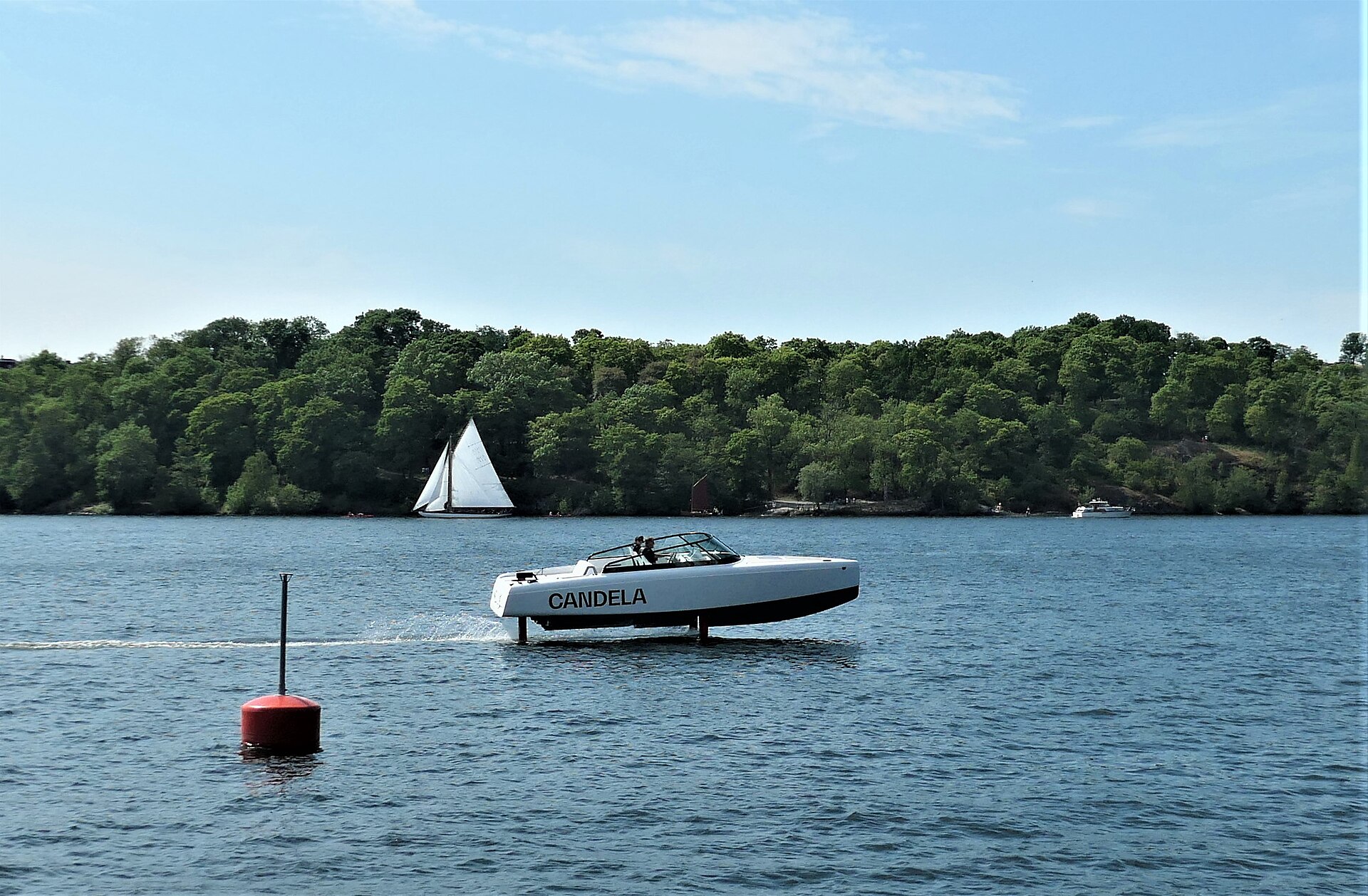
Say you have a 60 kWh battery, a free afternoon and a glassy lake. How far can you go?
Every electric boater asks it, and every honest answer starts the same way: it depends how fast you want to get there. Ask a petrol boater and they will quote you a tank. Ask an electric boater and they will ask you a question back.
That is not dodging. It is the single most useful thing to understand before you buy. We pulled the range figures makers publish at different speeds, and the pattern is the same on almost every boat.
The set wave: speed eats range
Water fights back harder the faster you push through it. Power rises much faster than speed, so going twice as fast costs far more than twice the energy.
The clearest proof is a boat whose maker publishes range at several speeds. The RS Pulse 63 is rated for these figures (RS Electric Boats):
| Speed | Range |
|---|---|
| 5 knots | 140 nautical miles |
| 10 knots | 70 nautical miles |
| 15 knots | 50 nautical miles |
| 20 knots | 35 nautical miles |
Four times the speed, a quarter of the range. Same boat, same battery, same afternoon.
Other makers show the same curve. The De Antonio E23 is rated for 50 nautical miles at 5 knots and 24 at 20 knots (Powerboat & RIB). The Riva El-Iseo does 50 nautical miles at 5 knots and 25 at 25 knots (MBY).
Reading the line-up: real range figures
Here is what a spread of boats sold in Europe are rated for. Always check the speed next to the range figure. A big number at 5 knots says nothing about 25.
| Boat | Type | Battery | Rated range |
|---|---|---|---|
| ESEA F800 | displacement cruiser | not stated | 120 nautical miles at 6 knots |
| Q Yachts Q30 | displacement cruiser | not stated | about 60 nautical miles at 6 knots (10 hours) |
| Pogo Loxo 32 | semi-planing cruiser | 53.2 kWh | 60 nautical miles at 8 knots |
| Candela C-8 | hydrofoil | 69 kWh | 57 nautical miles at 22 knots |
| X Shore 1 | planing day boat | 63 kWh | up to 50 nautical miles at 5 knots |
| Axopar AX/E 25 | planing day boat | 126 kWh | about 60 nautical miles at slow speed |
| Riva El-Iseo | planing runabout | 150 kWh | 50 at 5 knots, 25 at 25 knots |
Sources: float, Q Yachts, Oceanvolt, Candela, X Shore, MBY, MBY.
Small boats run on far smaller batteries. The Mercury Avator 7.5e outboard carries a 1 kWh battery and is rated for 34 nautical miles at 25 percent throttle (MBY). At full throttle that number drops sharply, as you would now expect.
Hull shape: the quiet decider
After speed, the hull decides most. Think of it like a longboard and a shortboard on the same wave: same water, very different ride. Three broad types behave very differently.
- Displacement hulls push through the water and stay slow. They are the range kings at low speed, which is why the long-distance figures above come from cruisers like the ESEA F800 and Q30.
- Planing hulls climb onto the surface at speed. They are fun and fast, but they need a lot of power to get up and stay there.
- Hydrofoils lift the hull clear of the water. That cuts drag at speed, which is how the Candela C-8 reaches 57 nautical miles at 22 knots (Candela).
If you want to go far and fast at the same time, foils are currently the strongest answer. If you want to go far and are happy to go slowly, a displacement hull does it for a fraction of the price.
Onshore days: what else drains the battery
The maker's figure is a calm-water number. Real days are not always glassy.
- Wind and chop. A headwind and short waves add resistance. Plan the return leg as the hard one.
- Load. More people, more gear, more weight, less range.
- Cold. Batteries give less in cold weather. Spring and autumn sessions deserve a bigger margin.
- Hull condition. Weed and growth on the hull add drag over a season.
- Extras. Fridges, stereos and heaters run off the same battery on many boats.
None of these are dramatic on their own. Together, on a bad day, they can turn a comfortable trip into a slow crawl home.
Do the maths: plan your own range
You can estimate range with two numbers: usable battery capacity and the power you draw at your chosen speed. Most boats show live power on the display.
Hours on the water = usable capacity (kWh) ÷ power (kW) Distance = hours × speed (knots)
Picture a boat with a 40 kWh battery cruising at a speed that draws 8 kW. Keep a fifth back as reserve and you have 32 kWh to use. That gives 4 hours. At 6 knots, that is 24 nautical miles, or 12 out and 12 back.
We plan with a margin of around a fifth of the battery, and more on open water, in cold weather or with no charger at the far end. Running flat on a lake is a wipeout. Running flat on the sea is a safety problem.
Charging along the way changes the sums completely. Read the guide to fast charging for boats in Europe before a longer trip.
Our verdict: plan for the speed you will actually use
So, how far can an electric boat go? Far enough for most sessions on the water, as long as you are honest about the speed.
If you cruise at 5 to 8 knots, many electric boats will outlast your picnic. If you want to hold 25 knots for hours, you need a big battery, a foiling hull or a charger on the route.
Read every range claim with the speed next to it. Then halve your confidence on a windy day and keep a reserve. That habit is worth more than any spec sheet.
For more before you buy, read electric boating explained, how to charge an electric boat and the rules for your water.
Questions
How far can an electric boat go on one charge?
Anything from about 15 to over 100 nautical miles, depending on battery size, hull and above all speed. The same boat can go several times further at 5 knots than at 20 knots.
Why does an electric boat lose so much range at high speed?
Water resistance rises steeply with speed, so the power needed rises much faster than the speed itself. Going twice as fast costs far more than twice the energy.
Do hydrofoil boats have better range?
At speed, yes. Lifting the hull out of the water cuts drag. Candela rates its C-8 for 57 nautical miles at 22 knots, which is more than many planing boats manage at that speed.
How much reserve should I keep?
Enough to get home against the wind. We plan with a margin of around a fifth of the battery, and more on open water or in cold weather.
How do I estimate range for my own boat?
Divide usable battery capacity in kWh by the power you draw in kW to get hours, then multiply by your speed in knots. The maker's figures at different speeds are the best starting point.