Boats
Catch the lift: how foiling electric boats work
Hydrofoils lift the hull out of the water and cut the energy an electric boat needs at speed. How it works, real figures and what it costs you.
9 October 2026 · 5 min read
Batteries hold far less energy than a fuel tank of the same weight. For slow boats that hardly matters. For fast ones it is the central problem. Hydrofoils are the most effective answer found so far. Instead of adding battery, they remove drag. It is like the difference between paddling through thick kelp and gliding over a clean face.
Picture yourself on a glassy morning, the water like a mirror. A normal boat hits 20 knots and starts pushing a mountain of water aside, burning energy like a flared gas pipe. A foiling boat just lifts off. It is the ultimate paddle out: once you are up on the foils, the resistance drops and you are flying. We have been looking at the numbers and the technology behind these flying machines. Whether you are comparing a foiler to a ROXEN recreational craft or a traditional planing hull, the energy savings are hard to ignore.
The idea: flying above the chop
A planing boat skims the surface, but its hull still drags through water and throws spray. A foiling boat goes one step further. Wings under the hull generate lift as speed builds, the same way an aircraft wing does, and raise the whole hull into the air. Only the slim struts and the wings stay in the water.
With the hull out of the water, most of the resistance disappears. The motor then only has to overcome the drag of the foils. For an electric boat, this is the difference between a session that lasts ten minutes and one that lasts all morning. It is a groundswell movement in boat design that is finally catching the big sets.
What the numbers say: reading the set
The clearest public figures come from Candela, a Swedish maker that is currently leading the line-up.
First, energy use. Candela says its foil system cuts energy consumption by about 80 percent compared with conventional boats. That is a massive reduction. At its launch in 2021, the 8.5-metre C-8 was reported to draw 16 kW at 22 knots. To put that in perspective, a conventional 28-foot cabin cruiser would typically carry a 300 horsepower petrol outboard.
With the 69 kWh battery it has used since 2023, the C-8 is rated at up to 57 nautical miles at 22 knots. By Candela's own comparison, a conventional boat of this size would need about five times the energy to do the same. These are the maker's own figures, measured in good conditions, and should be read with that in mind. But the direction is not in doubt: foiling changes what a battery can do at speed. For the general relationship between speed and range, see Electric boat range explained.
How the boat stays up: no wipeouts allowed
A foiling boat is unstable by nature. A fixed wing would let it pitch, roll and drop back into the water. Modern foilers solve this with sensors and computers that adjust the angle of the foils continuously while the boat is in flight. It is like having a world-class surfer constantly micro-adjusting their stance to stay on the wave.
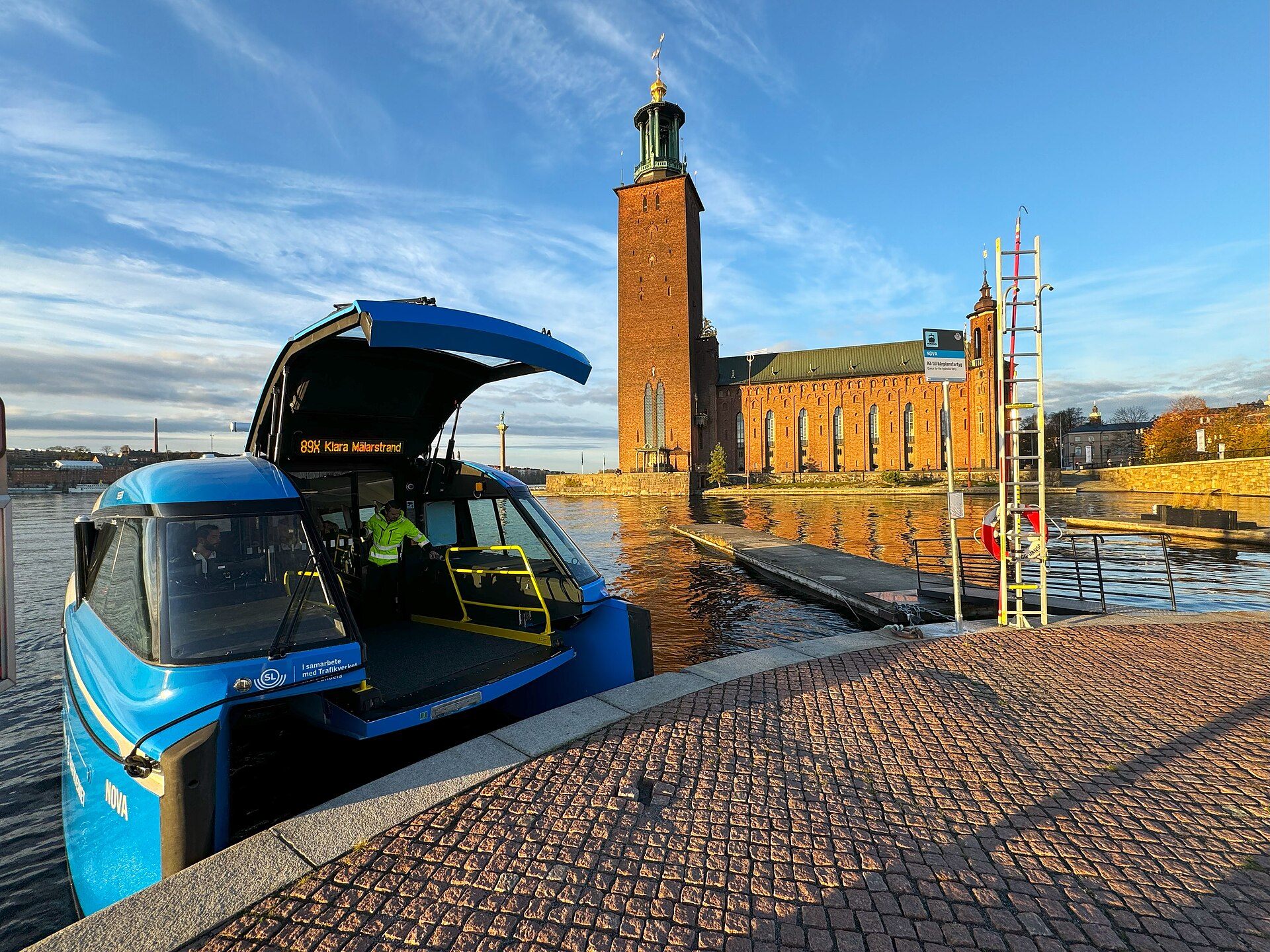
The effect for the people on board is a level ride. The boat flies above small waves instead of hitting them. Because the hull is not pushing water aside, it also leaves very little wake. That last point has a regulatory benefit: when Stockholm's first electric hydrofoil ferry was introduced, it was given an exemption to run faster than conventional passenger boats because it makes minimal waves. It is a win for the environment and the commuters.
From leisure boats to ferries: a growing groundswell
Foiling started in electric leisure boats and is moving into public transport. The Candela P-12 is a foiling passenger ferry that was introduced in Stockholm in 2024, running between City Hall and Ekerö. Its maker said that charging takes about one hour and gives about three hours of running.
The Norwegian operator Boreal has since ordered 20 of them for routes along the Norwegian coast, with first deliveries planned for 2027. The order was reported at about 29 million Swedish kronor per vessel. Boreal's chief executive repeated that 80 percent energy-saving figure and said the technology makes electric drive possible on routes where it was not before. It is a solid set of orders that suggests the tech is here to stay and will eventually trickle down to the rest of the line-up.
The same principle on a board: the eFoil session
An eFoil is the smallest foiling craft in the line-up. It is basically a surfboard with a mast, a wing and an electric motor under the water. The rider stands on the board and flies above the surface.
The principle is identical, and so is the benefit. An eFoil battery of about 2 kWh, weighing 13 to 14 kg, gives a ride of an hour or more. A board that had to push through the water at the same speed would need far more power. We compare the options in eFoil, electric surfboard or electric jet ski. It is a pure stoke experience that shows just how efficient foils can be.
What foiling costs you: the trade-offs
Foiling is not free, and there are some things you need to watch out for before you drop in.
Price is the big one. The C-8 was launched at 290,000 euros before tax in 2021, and by 2023 its United States price started at 395,000 dollars. Foils, actuators, sensors and software all add to the bill. Then there is the draft: with the foils down, the boat draws more water than a planing boat. Shallow harbours and slipways need care. Retractable foils solve this at rest, but not in flight.
Weight sensitivity is also a factor. A foiling boat has a take-off weight. Overload it and it will not fly, and all that efficiency is gone. You also have to watch for debris: foils run below the surface where logs and nets can cause a major wipeout. Finally, there is the complexity: more moving parts mean more to service, and fewer yards that can do it.
Who should consider one: the final verdict
Foiling makes sense when three things are true. You want to travel at 20 knots or more, you want to do it for more than an hour at a time, and you operate in water deep and clean enough for foils.
That describes commuter ferries well, and a certain kind of day boat owner who is stoked on high-tech gear. It does not describe someone who cruises at 6 knots on a lake. At displacement speeds, a simple hull is already efficient, and foils would just be an expensive way to add drag. For a small, fast craft, there is a third route, which is to cut weight until the battery needed is small. See Electric jet skis and personal watercraft in 2026. But if you want a real cabin cruiser that can fly, foiling is the only way to catch that wave.
Questions
How much energy does a hydrofoil save?
Candela, the best-known maker, claims a reduction of about 80 percent at cruising speed compared with a conventional planing boat.
How fast do foiling electric boats go?
The Candela C-8 cruises at 22 to 24 knots and was launched with a top speed of 30 knots.
Are foiling boats stable?
Modern foiling boats use computers to adjust the foils many times a second, which keeps them level in flight. They ride above small waves instead of slamming through them.
What are the drawbacks of foiling?
Price, deeper draft when the foils are down, sensitivity to weight and to debris in the water, and more systems to maintain.
Is an eFoil the same thing?
It uses the same principle on a board. An eFoil is a surfboard with an electric motor on a mast and wing below the water.